
Journal—
Musings & Observations
I’ve written for The Atlantic, Huffington Post, Forbes, Warwick and my mom.
You can also see the Magazine view.
Philosophical Therapeutics
Here's Keith Ansell-Pearson:
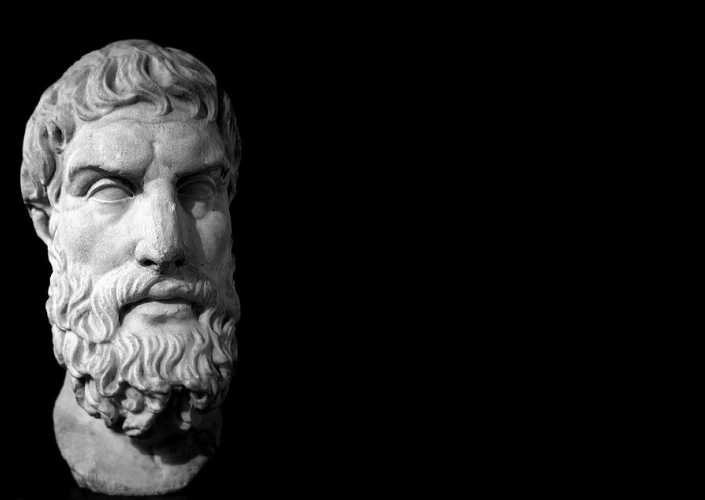
"Dawn can be read in part, and on an existential or therapeutic level, as an attempt to revitalize for a modern age ancient philosophical concerns, notably a teaching for mortal souls who wish to be liberated from the fear and anguish of existence, as well as from God, "metaphysical need", and romantic music, and are able to affirm their mortal conditions of existence."
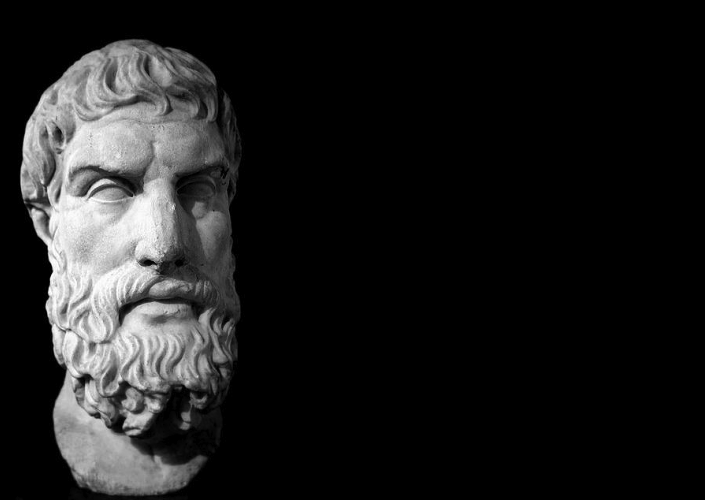
Whereas for Nietzsche, who sought to cultivate a philosophical therapeutics, as Keith Ansell-Pearson advances, Arakawa and Gins, thinkers of reversible destiny, strive to afford a pedagogical aesthetics. Epicurus's fundamental insight: "For there is nothing fearful in life for one who has grasped that there is nothing fearful in the absence of life...the wise man neither rejects life nor fears death." For Arakawa and Gins, this line of thinking misses the crucial point, of great ethical concern, which is that we must cultivate a new attitude towards existence: death itself can and must be overcome.
Nietzsche, instead, attempts to utilize this ancient philosophical tradition, which stages existence in terms of our mortal condition, to afford the modern age an existential appreciation of life. Nietzsche hopes to teach the affirmation that is required to embrace a new type of life without fear and torment, one that is liberated from any metaphysical needs. Of course, Arakawa and Gins would endorse this form of philosophical therapeutics, "centered on a concern with the healing of our own lives, so as to return us the pleasure and joy in existing", but they would want to take it one step further.
Nietzsche himself is concerned to address the transitional humanity, "moving from a heritage of religions and moralities to something new, in fact, to uncharted conditions of existence". The pedagogical aesthetics that Arakawa and Gins establish, is one of self-discovery, and self-exploration, an education based on an aesthetics of existence. Yet, following Arakawa and Gins, we wonder if this new humanity is not already underway, in the thought of reversible destiny. But, as Keith Ansell-Pearson rightly reminds us, "Our task is now to take our time in our search; we are no longer looking for a single answer to our questions or some ultimate solution to the riddles of existence."
Dawn has just been released as part of the Nietzsche Collection.
Switch Hands
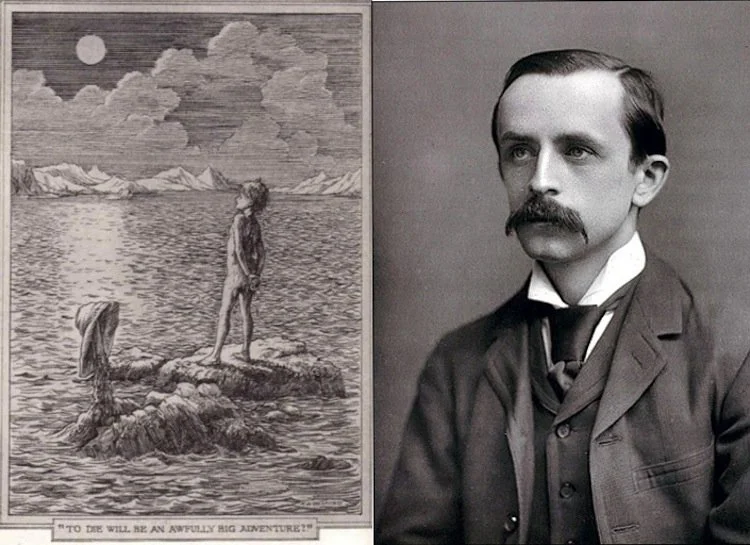
In the notebooks of J.M. Barrie, the left-handed person is described:
"I find the person who writes with his left is quite another pair of shoes from the one who employs his right; he has other standards, sleeps differently, has novel views on the ontology of being, and is a more sinister character.” - J.M.Barrie, Letters of J.M. Barrie, 1917, pg.38.
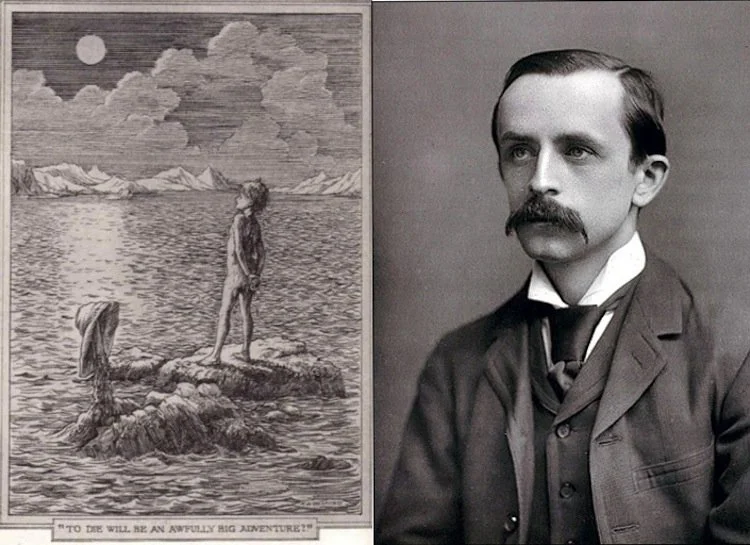
In a remarkable turn of events, when Barrie sat down to write Peter Pan, he struggled. He just couldn't write. So, what did he do? How did he overcome this obstacle? He switched hands.
Here's a little interpretation of this reversal: J.M.Barrie implemented the innovative practice of switching hands when confronted with the impossible; for it is no longer a matter of facing the absolute, but of escaping the plane of representation and entering the flatbed ontology of ‘becoming without being’. Turning to his left like an adult turns to the child of the present.
How, in turn, can one describe such a left-handed person? asks Barrie. As one that forms rifts and shocks, perturbations that resonate throughout chronological time, allowing, in this case, Peter Pan to become formless: that is, immersed in the pure, empty form of time. A non-pulsed, floating time, seething with the potential of an event; assembling connections and flows, turning things into vibrations that are released at the site of confrontation. This non-metric continuum demands experimentation.
Or as Barrie witnesses, "it is as if you had played it until you tired of it, and tossed it in the air and gored it and left it derelict in the mud and went on your way singing other songs; and then I stole back and sewed some of the gory fragments together with a pen-nib. That is what must have happened, but I cannot remember doing it. I have no recollection of having written it."
Switch hands. See the world anew.

iA Writer

When Oliver Reichenstein, and the incredible team behind Information Architects first launched Writer for iPad, I was as eager to test and experiment with the app, as I was to start a new writing project. I felt inspired. Of course, a few months later, and with unabated interest, Writer for Mac was introduced, and my world was completely upturned. Since then, these two writing apps, iA Writer for iPad and Mac, have become my definitive writing tools. They're simple and effective.
Here's why: Writer removes the obstacles of perfection from the task of writing. Let me explain.
Since finding Writer, I've decided to write my entire PhD dissertation, tentatively entitled, "Arakawa and Gins: Philosophers of Life", solely using Writer. Is it any surprise that Oliver Reichenstein has a background in philosophy? He's aware of, and asks, tough philosophical questions. "What happens to thought in relation to writing?" "Will the user interface precipitate new modes of production?" "In an age of distraction, how can we concentrate and focus the user?" Here's Oliver, with a little twist: "With Writer all your thought goes into what you write, not how your writing looks."
When I first started my dissertation, I was more interested in ontology and mereology, than I was aesthetics and pedagogy. But things have changed, and I've developed an interest in typography and design, largely thanks to . Our experiences with Montessorium have opened new possibilities for what encounters are possible with such aesthetic and pedagogical interactions. A new way of learning, and engaging with thought, is already here.
As this personal interest continues to grow and mutate, I continue to think about the ways in which we encounter the world, and the way the world encounters us, both in terms of making your life a work of art (aesthetics) and in terms of learning how to educate oneself endlessly (pedagogy). Is the task of education not one of self-education? This intersection, so timely and essential, has become the primary focus of my thinking.
Enter Writer.
Writing in a clean and uncluttered environment, with a cursor so beautiful it's hard to be afraid of or afflicted by the blinking reminder to persist, despite the procrastination or absence of inspiration, Writer is a dream. It lets one go on, and on, as Gertrude Stein illustrated so majestically with the comma. Writer offers a radically new writing experience, primarily because it creates a space in which to write, one devoid of the constraints of perfection. Perfection, in this, and many other respects, limits construction. These are lessons we have learned from Graham Harman, amongst others.
Writing everywhere else just isn't the same. Not since I first learned how to put pen to paper, which, incidentally, I can never read have I been so thrilled to actually "sit down" and write. It helps to alleviate some of the pain and frustration of bringing something new into the world. I've always been on the look out for writing experiences. When I wrote a paper on Bataille, for instace, I ordered a typewriter to address the violence and brutality of the topic. The pages literally bled. The ink soaked through. With Writer, however, it's a completely unique experience. The words seem to conspire.
When I opted to use Writer for my dissertation, a number of questions were immediately presented. "Who will read my dissertation?" "In what format, and in what environment - not only on what device, but in what climate and geographical location - will they work through my chapters?" Before Writer, I also thought, "What font would best capture or convey the spirit of my work on Arakawa and Gins?" Knowing, in particular, that Madeline Gins had used Courier in the past, and that Arakawa had a disposition towards capitalization, these seemed like relevant and necessary lines of inquiry.
But this is how Writer works:
"Our goal was to create a writing app without settings. When opening Writer, all you can do is write. The only option you have is full screen and FocusMode." Of course, it helps, and is crucial, that 1) the environmenet is unencumbered, but also 2) that it's beautiful. Writer accomplishes both of these traits, in equal measure. Writer purrs in ways that only your fingers will learn.
Is Writer the perfect writing tool? In our estimations, it comes pretty close. Only thing better? If it'd write for you. Of course, there are other writing tools. We've seen Phillip Roth, for instance, seated before his special device, and boy does he have quite the outpouring. Speaking of which, I'd be curious to learn what Joyce Carol Oates uses to write. Maybe she'd like to try out Writer?
My biggest criticism of Writer, and it isn't a critique, so much as a feature request, would be to include the capability to add video and images. The reason? Perhaps it's more philosophical, than practical, but I would find the incorporation of media helpful. For better or worse, we've increasingly become accustomed to using and relying on these forms of interaction to help articulate and emphasize how we write, and what subjects we choose to address.
P.S. A little update for Mom: Four chapters down. Two to go. I plan to be finished before the end of the century. I promise. And, yes, no more long blog posts.

Gorilla in a Pink Mask

One of Banksy's early works, "The Gorilla in a Pink Mask", as pictured above, was recently and "unknowingly" a product of emulsification. Of course, that's the word the Guardian chose to describe the affair. We could probably come up with others, but it does a nice job of avoiding some crucial and categorical clarifications.
Basically, the famous gorilla from Bristol was painted over, and essentially destroyed, by the director of the new cultural center, who operates the building. When asked about his actions, he responded: "I thought it was worthless. I didn't know it was valuable. That's why I painted over it."
Needless to say, this raises a number of interesting questions, both on the nature of the "construction" of a work of art, and also, on the 'act of destruction'. What further complicates this interesting story, is that followers and admirers of Banksy are calling the act vandalism.
Update: Philosopher Timothy Morton weighs in here.