
Journal—
Musings & Observations
I’ve written for The Atlantic, Huffington Post, Forbes, Warwick and my mom.
You can also see the Magazine view.

Savage Beauty

There's something extraordinary about the Savage Beauty exhibit.
In the introduction to Anti-Oedipus: Capitalism and Schizophrenia, published in 1972, Michel Foucault once famously remarked that 'perhaps one day this century will be known as Deleuzian'.
Alexander McQueen -
"When I'm dead and gone, people will know that the twenty-first century was started by Alexander McQueen."
Despite the hubris, and in spite of the flamboyance, he was on to something.
You feel a sense of vital movement in his couture. Like a wind, steadily blowing in your face, confidently reassuring you of the course, even if it's not readily apparent, and you have to traverse unbeknownst obstacles ahead.
The work is not weighted down by despair or destruction. Rather, it's uplifting, even in its darkness - jarringly so, one would conjecture. It's a wellspring of hope and defiance, a resistance to that which subsumes the death spirals of existence.
"There's no way back for me now. I'm going to take you on journey you've never dreamed possible."
"I oscillate between life and death," says McQueen, like a seasoned ferryman.
There's a feeling of complete and utter unrest in his work. Of not being satisfied. Of striving. Of always trying to keep on moving, back and forth, until the forth takes us somewhere new.
Movement is a major theme in the retrospective of Alexander McQueen. Nothing is static. It's all trying to get somewhere, even if it doesn't know where. Certainly, McQueen took us to places we never knew we could find.
"You've got to know the rule to break them. That's what I'm here for, to demolish the rules but keep to tradition."

Bento’s Sketchbook

My book of the year award goes to Bento's Sketchbook, by John Berger. Here's the official blurb about Bento's Sketchbook: "The seventeenth-century philosopher Baruch Spinoza, also known as Benedict or Bento de Spinoza; spent the most intense years of his short life writing. A sporadic draughtsman, he also carried with him a sketchbook. After his sudden death, his friends rescued letters, manuscripts, notes;but no drawings."
"For years, John Berger has imagined finding Bento's sketchbook without knowing what its pages might hold, but wanting to see the drawings alongside his surviving words. When one day a friend gave Berger a beautiful, virgin sketchbook, John said, "This is Bento's!"; and he began to draw, taking his inspiration from the philosopher's vision."
"The result is Bento's Sketchbook, an exploration of the practice of drawing and a meditation on how art guides our gaze to the world: to flowers, to the human body, to the pitilessness of the new world order and the forms of resistance to it."
With moments of resounding clarity and insight, Berger reveals that which remains imprisoned and mysterious. He strives to capture the ephemeral and fleeting. "I began to make drawings prompted by something asking to be drawn." What is aloof, but speaking to us, he actively tries to present.
"We who draw do so not only to make something observed visible to others, but also to accompany something invisible to its incalculable destination."
Berger is our contemporary. As if accidentally, but that's not quite right, Berger sets out to provide a new type of book, a book with images, texts, and quotes. Images of his own construction, quotes of the great Spinoza, salted with Berger's stunning text and prose.
Further still, Berger sets out to articulate the conditions of exposition, of creation, and juxtaposition. "You lose your sense of time when drawing. You are so concentrated on scales of space." It is with Berger, that we wish to share. "I'm taking my time, as if I had all the time in the world," shares Berger.

Two Titans
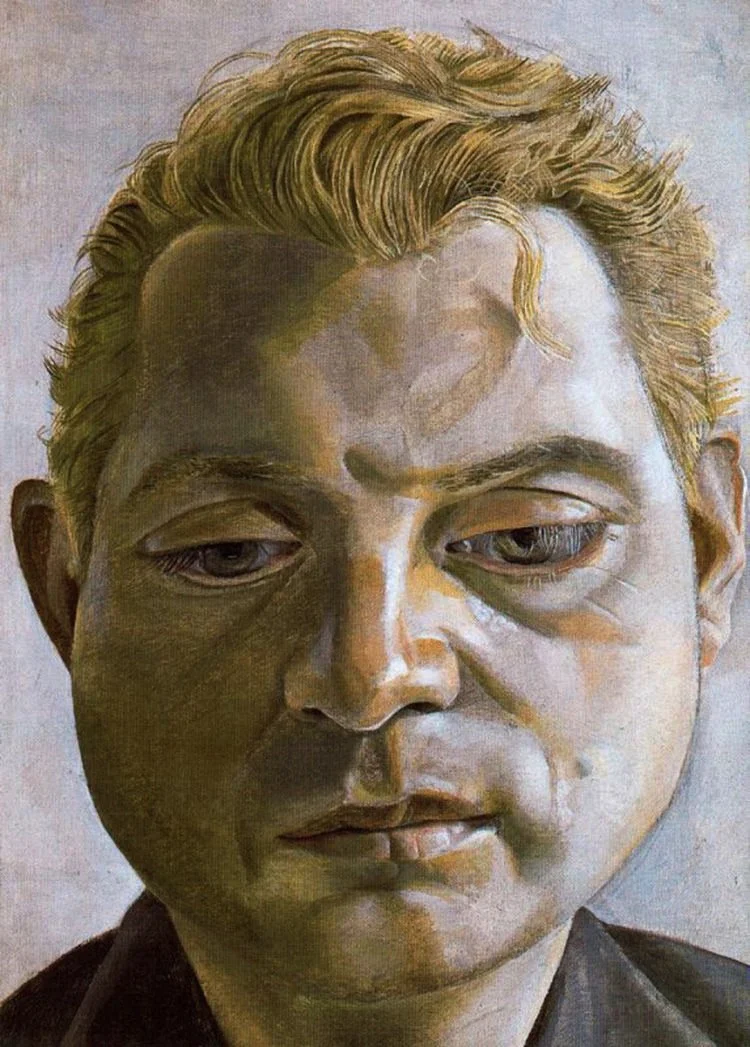
Two titans of the twentieth century: Francis Bacon and Lucian Freud.
The critic, writer and curator Martin Gayford once wrote that Bacon's famous phrase, "the brutality of fact", applied to the work of Lucian Freud. David Sylvester disagreed, and responded, "Bacon hit upon that phrase when trying to define a key quality which he found in Picasso but found wanting in Matisse, a quality that clearly involves a sense of the human condition, which in turn demands a measure of universality. Freud seems to see the world at close range through his own eyes only, painting attractive or repulsive sights according to his personal whim."
In turn, Gayford formulated his riposte, in his exceptional book, "Man with a Blue Scarf", "It is exactly Lucian Freud's treatment of the world as made up entirely of unique individual things - people, animals, objects - that is his greatest strength. He has resisted the tendency of modernist art to subdue the complexity of the world to a style or a concept. But maybe the 'brutality of fact' isn't a phrase that precisely suits what he does. Perhaps, the 'awkwardness of truth' would be nearer the mark."
These two friends operate and explore the world at vastly different ends of the spectrum, especially in terms of technique, style, and execution. Yet, in many respects, they couldn't be more inapposite allies in a battle against the banal. The fixed, the stable, the inert, especially the inert, is called into question, in a radical and germinal fashion. Take, for instance, Freud's criticism of Vermeer, "It isn't a matter of incompetence. It is that in a funny way his people just aren't there."
Don't be mistaken, though, it's not the theater of art that interests Freud and Bacon. Instead, it's the un-theatrical. Here's Freud on 'why he doesn't like taking drugs'. "People say such things as, "Oh, they make me see such marvelous colors" - which to my mind is a horrible idea. I don't want to see marvelous colors. I want to see the same colors, and that is hard enough. Then they say that they are taken out of this world, but I don't want to be out of this world, I want to be absolutely in it, all of the time."
Which, takes us to Freud's remarkable definition of imagination. He defines it, as such: "A great deal of what is normally thought of as intelligence, he points out, is actually imagination - that is, an ability to see things as they truly are." On this model, imagination is active, and engaged, as it participates in the world, leaving no room to confuse intelligence with imagination.

Gorilla in a Pink Mask

One of Banksy's early works, "The Gorilla in a Pink Mask", as pictured above, was recently and "unknowingly" a product of emulsification. Of course, that's the word the Guardian chose to describe the affair. We could probably come up with others, but it does a nice job of avoiding some crucial and categorical clarifications.
Basically, the famous gorilla from Bristol was painted over, and essentially destroyed, by the director of the new cultural center, who operates the building. When asked about his actions, he responded: "I thought it was worthless. I didn't know it was valuable. That's why I painted over it."
Needless to say, this raises a number of interesting questions, both on the nature of the "construction" of a work of art, and also, on the 'act of destruction'. What further complicates this interesting story, is that followers and admirers of Banksy are calling the act vandalism.
Update: Philosopher Timothy Morton weighs in here.