
Journal—
Musings & Observations
I’ve written for The Atlantic, Huffington Post, Forbes, Warwick and my mom.
You can also see the Magazine view.

Thoughts on Architecture
Life thrives when its creatively challenged by its environment.

If architecture has taught me anything about life, it’s that life thrives when it’s actively fostered, continuously supported, and creatively challenged.
I believe the same can be said for “learning”.
When learning is supported, when what is ‘taught is taught’, with a mindset that is as open as that which learning opens - everything flourishes. Of course, the opposite can be true and this is the slippery slope we carefully navigate.
In a curious quote, one that demands rumination, patience and incorporation, G.K. Chesterton writes,
“The object of opening the mind, as of opening the mouth, is to close it again on something solid.”
All that is learning is that which encounters the new.
When a positive framework of nurture and care are implemented, with maintenance and subsistence, giant leaps of self transformation spawn into a state of perpetually taking flight.
Everything else recedes.
Gabriel Garcia Marquez:
“The scalpel is the greatest proof of the failure of medicine.” What these words highlight, with astounding precision and generality, is our profound, and interrelated relationship to the world.
Nothing happens irrespective of everything.
Learning needs to be taken into consideration - considered the exact same way as an apprentice who observes a master progressively rendering themselves obsolete.
I believe this applies to life - and if an architecture of life exists, a learning of life, our role is to actively support and serve as a catalyst to these pathways.
The old adage rings true - if you create the conditions for success, success begets success.
Learn to Read
For the past few weeks, and at the suggestion of Madeline Gins, I've been working with a copy editor. My eyes have been completely opened. I feel the way a newborn must feel, as her mother tends to her matter-laden eyes with such measured and well-intentioned movements. It's as if an entirely new set of circumstances has suddenly, and more clearly, been laid out before me. Why couldn't I see this way before?
Truly, I want a copy editor to review everything that I write. In many respects, I can now feel "my editor" as she kneads the words in my head, even before they're pressed upon the page. "It can be smoother still," I can hear her iterating. Working with her has been such a profound, illuminating experience. It's almost like the sensation I experienced when switching from the brutality of a typewriter, to the grace and ease of a computer. I can still feel the keys tingling beneath my fingertips as I read her suggested revisions. And, of course, she's been right virtually one-hundred-percent of the time.
I can feel her as she carefully wades into the text. She's so attentive not to interrupt the flow. Yet, you can still sense her presence, as she works to uplift the man-made boulders from the middle of the restless stream. Visually, I see and take note of her comments and suggestions. I try to plot out their alternative courses of action, and what they might mean for the rest of the text. The margins come alive, even as they sever their connections to the body of work, in a way that they always should, with vigor and focus. To be sure, looking from the shore is an acquired perspective.
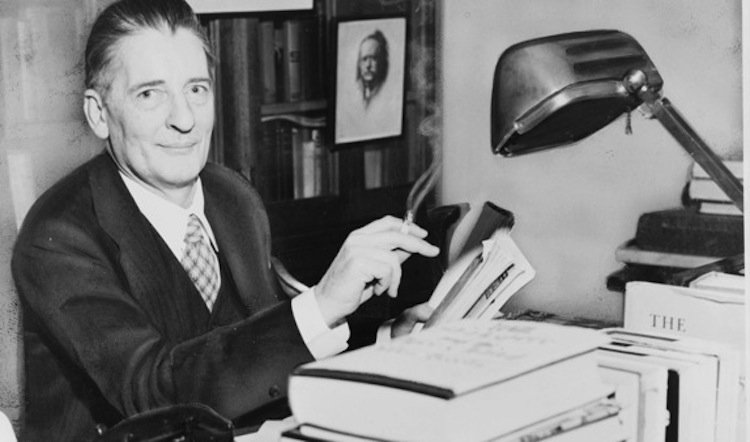
Alongside this momentous discovery, which I'm still trying to digest, I've recently stumbled upon the work of Max Perkins. This might sound ironic, since he's primarily known as the editor and confidante of some of the last centuries greatest literary titans: Ernest Hemingway, F. Scott Fitzgerald, Thomas Wolfe and the affably talented Marguerite Young. Have you read Miss MacIntosh, My Darling? Needless to say, I've been thinking a lot about the relationship between an editor and an author. Mandy Brown has unearthed some wonderful comments by Perkins on this precise subject. You can read them here.
Perkins once offered writing advice to a young servicemen eager to take up his pen. He wrote: "I think, in truth, that the best writing of all is done long after the events it is concerned with, when they have been digested and reflected upon unconsciously, and the writer has completely realized them in himself. It is good journalistic writing that is done quickly while everything is still new, but not the best writing. . . " Living in the age of the blog, when journalism itself has been called into question, I find this advice extremely refreshing. Further still, I was struck by what I perceive to be his single best piece of advice: "Learn about writing from reading."