
Journal—
Musings & Observations
I’ve written for The Atlantic, Huffington Post, Forbes, Warwick and my mom.
You can also see the Magazine view.

Individualized Learning Isn’t about the Individual

There’s a widespread conception that individualized learning is solely about the individual. That by personalizing education, we’re only focusing on the individual needs of the student, outside the constructs of a larger community. Community, so the theory goes, suffers at the hands of the individual.
When we think of Socrates and Plato, or Plato and Aristotle, or Aristotle and Alexander the Great, we’re mired in imagery of individualism. A teacher instructs a student, a student then goes on to instruct their own students, and everything happens in isolation, removed from any sense of community.
Learning may participate in universal conversations, but the perception is that individuals participate in singular conversations. There is a master and a disciple, a clear hierarchy where the autonomy of the student is subsumed by the authority of the master. When the student becomes the master, the hierarchy perpetuates itself further. Any interactions that transpire outside this relationship are relegated, not to collective participation but to perceived individualism.
Picturing traditional education, this is exactly how we envision it. There is no Socrates or Plato or Aristotle, let alone the space to indulge in personalized learning. Instead, we find ourselves carefully seated in neatly organized, alphabetical rows. The teacher stands at the front of the room, easily accessible to the eyes of her seated students. She shares a single, often mandated, curriculum. Do Plato or Aristotle make the list?
Traditional education is a panopticon of learning. The lessons are for everyone, and everyone is expected to pay attention, despite their interests. If their interests lead them astray, the teacher carefully directs their wily exercsions back onto the proper path. Ironically, perhaps, it is the teacher who is individualized in traditional education. The role of the institution is to individually train the masters.
What happens to the students?
If individualized learning happens in the traditional model, by which we mean students are afforded personalized learning opportunities, it’s either the case that the student is advanced and can use some extra work to keep motivated and inspired or the student is lagging behind, and needs special care. In both of these scenarios, the students are typically escorted from the room, assigned to a separate, more specialized mentor and space. To this day, many of us wonder if we were ahead of our peers or behind.
There are no hierarchies, only a commitment to learning. The environment itself is prepared as a community.
When we imagine individualized learning, which is largely pioneered in communal type settings, often exhibited in Montessori classrooms throughout the world, an entirely different panorama presents itself. The panopticon is fragmented into a new perspective and appreciation for education, for the student and teacher. There are no hierarchies, only a commitment to learning. The environment itself is prepared as a community. Responsibility is a communal effort, not an individual one. In Montessori environments the students and teachers take care of the environment, the way the environment takes care of them.
There is no teacher who stands at the front of the room, orating the lessons of the day. There are no desks, adroitly organized in rows. Instead, there is a cornucopia of students who are free to move and explore their interests, learning at their own pace, in a mixed-age classroom, based on their individual needs. Who thought children of a certain age learned the same? The role of the teacher is also displaced, from that of the master, to that of the student, from individualizing their own roles, to individualizing that of their students. If there is an institution of personalized learning, it consists of empowering students.
Picturing a traditional classroom, we often think of community. There is a community of learners following their teacher, participating in lessons. Picturing an individualized learning environment, in this case a Montessori classroom, something else happens. We envision students working independently, irrespective of their peers. What this perception fails to appreciate is the communal nature of personalized learning.
What is at work here?
What role does community play in individualized learning? Is individualized learning really only about the individual? In our estimations, nothing could be further from the truth. In personalized learning environments, such as Montessori, there is an entire ecosystem of collaboration, a dynamic that is often unspoken, yet always present. The teacher, referred to as a guide, follows the student. The student actively participates in the community. The community is dynamic. It’s not predicated on competition, where the students are encouraged to usurp their peers. It’s predicated on collaboration, where the children naturally strive to surpass themselves, supporting their friends in their efforts. This is a rich and vibrant community that helps to foster and strengthen the entire community.
Whereas in traditional education the individual student is not essential to the functioning of the classroom and only the teacher is essential, with individualized learning there is a paradigm shift. The individual student, while working independently, is part of the larger community and quintessential to its flourishing.
The vocabulary that has been adopted to describe personalized learning environments often focuses on the individual: self-driven, self-motivated, self-disciplined, to name a few. What are similar terms for community? Despite these characterizations, we’d wager that individualized education is primarily concerned with community. How the community functions reflects on the individual. How the individuals function within the community reflects upon the learning environment. No one is excluded from an inclusive approach.
What is at play is a new type of community, one that is free minded, open, willing to experiment and create, committed to thinking, feeling, and uninhibited by the self.

Invent Your Own Questions
This interview with philosopher Miguel de Beistegui intersected my life at a really interesting time.
When asked if philosophy can contribute to the resolution of concrete problems, de Beistegui answered passionately:
"I feel quite strongly about this," he explained. "The singularity and task of philosophy is not, as Popper famously said, to solve problems, whether of an epistemological or social nature. It is to construct problems."
I think this distinction, between "solving problems" and "constructing problems", is a really important differentiation, one that is often overlooked or willfully ignored.
More boldly, this focus on constructing problems is a paradigm shift in how we think about the role philosophy plays in everyday life, and perhaps more specifically, how we can think concretely about figuring out problems.
One thing is clear.
Philosophy has a fundamental role to play.
While there may be readymade answers for readymade problems - literally ready at hand - when you construct a problem and examine its very composition, an entirely different landscape is at work.
What does this mean?
Well, "as Deleuze says", de Beistegui articulates, "we always get the answers and solutions we deserve on the basis of the problems we construct."
Asking the right questions, then, and finding a way to construct a problem, becomes of critical and necessary import. If you have an answer, it might mean that it's a poorly posed question.
All too often, the landscapes we visit are all-too familiar. We feel comfortable with the answers, because we don't examine the questions.
The role of philosophy is to construct problems. This approach flips the widely accepted reliance on answers squarely on their perfectly rounded heads.
Miguel de Beistegui goes on to address the politics of philosophy. He states that philosophy must refuse the structure of thinking in terms of solutions, and resist the false powers that hold us hostage.
"The politics of philosophy consist first and foremost, and initially, in not allowing power – political, scientific, mediatic, etc. – to impose problems on us."
Quite literally, we must resist the manufactured conditions by which a solution is arrived at by approaching the problem with a question. As de Beistegui expounds, "We need to ask," upfront, "in whose interest is it to formulate the problem in that way, to emphasize this or that problem, and to then demand that we think of a solution."
One of my absolutely favorite quotes, which speaks directly to this line of thinking, and is a philosophy I have stoutheartedly adopted myself, comes from Deleuze:
"Most of the time, when someone asks me a question, even one which relations to me, I see that, strictly, I don't have anything to say. Questions are invented, like anything else. If you aren't allowed to invent your questions, with elements from all over the place, from nevermind where, if people "pose" them to you, you haven't much to say. The art of constructing a problem is very important: you invent a problem, a problem-position, before finding a solution."
Invent your own questions.
P.S. I have been thinking a lot lately about mentors and how they rarely know how they affect our lives. It's only later, when the lessons they taught us are fully incorporated into our everyday lives. Miguel de Beistegui, perhaps unbeknownst to himself, directly impacted my life in a very positive, meaningful way, by teaching me the power of failure and giving me the courage to overcome my mistakes.

Learning is an Always Everywhere Adventure

Meet Gordon Bearn, Professor of Philosophy at Lehigh University, and my personal inspiration. I sent him a note and asked him who inspired him.
Q: Who has inspired you to learn?
A: Almost every Wednesday afternoon, during the Winter of my sophomore year, Tim Jones, Allen Wall and I would walk a little way off campus to the house of Mr. Lawrence, Professor Nathaniel M. Lawrence to the wider world. There for the next three hours, with three other students, we sat comfortably on two couches, two Golden Retrievers stretched out on the living room floor, and with an old edition of Kierkegaard on the arm of his well worn armchair, he taught us Existentialism. Anyway that was what the course was called, but it was impossible for him to talk about anything without talking about everything. In detail.
My recollections of the experience of those long afternoons is inseparable from the inspiration Tim and Allen and I gave to each other. Our assignments were extraordinarily difficult. And long. Exchanging Kierkegaard or Sartre thoughts, we would wander from libraries closed at 2:00 to Wall’s living room and talk and talk. We barely slept, especially Tuesday nights. By the time we walked into Mr. Lawrence’s living room, we had already had more than one seminar, together. Apart from a living conversational community, I don’t suppose philosophy can even exist. Perhaps nothing can.
We thought Mr. Lawrence was probably old: he had learned logic from Henry Sheffer, and while telling us about Alfred North Whitehead, he would imitate Evelyn Whitehead’s English accent. But Mr. and Mrs. Lawrence were much younger than we imagined. Besides bare bones Ikaria sabbaticals, the High Sierras every summer, and the Himalayas on a recent trip, they seemed to have climbed every mountain visible from their home. What, gesturing, he said to me once: you’ve never climbed The Dome?!
It was a not infrequent tone. He could never believe how little we had read or seen or done. I suppose it was sort of a compliment, he could never believe that our side of the conversation was so inexperienced. What, he told our class: you haven’t read the Symposium? Read it this weekend! There was never any thought that our learning would be restricted by syllabi. And with Ancient Greek especially, but German and French too, he was always telling us about linguistic idiosyncrasies and assuming that we too could read the untranslated books he told us about.
Later I taught for a year with him at Williams and during that time Ellen and I would sometimes be invited to climb the neighboring hills with him and his wife Mary. We were walking together, talking about something. Suddenly he drops to his knees, shouting something in Latin. Nose to the earth, he is gently digging out an apparently rare fungus. Slowly he gets up, cradling the fungus to a spot a little deeper in the woods where it could avoid the danger of Vibram soles. Knowledge of fungi was as much a part of his philosophical life as being a multilingual scholar.
Nathaniel, as I came to call him, cared or seemed to care about the whole of nature and humanity. That was what he wrote about and taught about, and so fungi were no less important to him than De Broglie’s microphysical wave packets, and either or both could surface in just about any discussion. In that Existentialism course, we talked as much about Newton’s conception of time as we talked about whether we could trust Victor Eremita, the fictional editor of Either/Or. We learned that he had built the coffee table in front of the couch as a smiling challenge to Plato’s thought that ever object only participated in one form – it was meant to be equally bench and table.
The learning may have gone both ways. Since I was enrolled at the time in a course on 20th C theater, something in Sartre or Kierkegaard started vibrating with Six Characters and I said so. He didn’t see it, so I was invited to explain why and I am sure he responded in some way but perhaps because my task had rendered me timid, I have forgotten what he said. I was pretty scared every Wednesday, it took one agonizing week before I even asked him where the bathroom was.
Two summers before our Existentialism he had visited for the first time Japan. He returned amazed at the linguistic peculiarities of that language and immediately hired a student to teach Mary and him, once a week, Japanese. Like Socrates late in life beginning to learn to play the lyre, like a grandfather planting an Oak seedling, the Lawrence’s at their age, beginning Japanese, that has always impressed me. Since learning extends to all of nature and is always exciting, it is never finished, and there is no time to late to begin. Learning is unlimited by syllabi, libraries, roofs of any kind. Learning is an always adventure.
Adventure was one of Whitehead’s favorite words, and it was with Whitehead that Nathaniel began his philosophical education. I had developed an affection for Whitehead already when I asked Nathaniel to guide an independent study on Philosophy of Biology. Of course there were books and books to read over the summer, but what I really wanted to do but was afraid to ask was to read Whitehead with him. Slowly as the semester moved on, it became clear that I kept asking to read another book of Whitehead’s, and the meetings of my independent study became Whitehead meetings.
Sometime in early November, Nathaniel asked me what we were doing. I said: an independent study. And he pointed out that meeting weekly was not very independent, and we should stop our weekly meetings. I was shocked, felt even a little rejected. But off I went and read Whitehead and Lawrence and others on Whitehead, and the reading and learning has never stopped. Even then I thought of a picture in one of Jane Goodall’s books. A mother Chimpanzee is weaning her child: a hand placed on her child’s head, her long arm stretched out straight kept her breast frustratingly out of reach, and the child’s adult adventures finally possible.
Q: What did they teach you?
A: Learning is an always everywhere adventure.
Originally published on Montessorium, February 14th, 2014.

Imagination
We had a wonderful conversation with a three year old student about imagination. It went something like this: "We love your new tie-dye shirt. Can you tell us about it?" The boy responded thus, "I made it with my mom." With a grin on his face, he enthusiastically continued, "We colored the world." His mother, looking as proud as a peacock, rejoined, "How about that imagination?"
Now, this exchange instantly jumpstarted a series of questions: What is imagination? How is imagination to be understood? Is it possible to teach imagination? Do our judgements inform imagination? Further still, and to encapsulate our fundamental question: what role does imagination play in education?
Imagination, to be sure, is extremely difficult to define. There's no ready-made taxonomy for thinking through imagination. Interpretations vary widely. Traditional accounts, philosophical as well as cultural, typically put forth the thought that imagination is, roughly speaking, an ability to form a mental representation of something imagined.
An example of this characterization is as follows. You instruct a three year old to close their eyes and imagine life on Mars. "Use your imagination", we encourage, as we hand them a blank piece of paper and a packet of colored pencils. As a part of the exercise, perhaps we lay out the basic criteria of the terrain, i.e. "Mars is a planet that is hot, red and far away. There may be life there," we mention. "But, we can't be sure."
A few minutes later, we return to the table to see a small red circle enflamed with what appear to be ants, or aliens. We can't quite make it out, but we surmise that the purple colored flecks are invading the surface of the planet with vigilance. "What intelligence", we think to ourselves, as we praise his imagination, and his creative application.
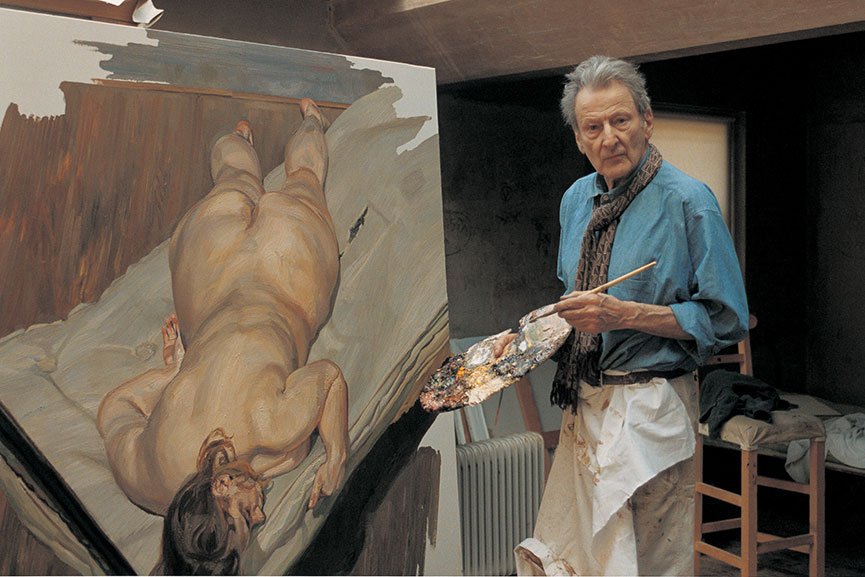
The great British painter Lucian Freud, however, develops another approach to imagination. In almost direct riposte, he claims: "a great deal of what is normally thought of as intelligence, is actually imagination - that is, an ability to see things as they truly are."
With this assessment, Freud arrives at a new definition of imagination. It's important to note that for Freud, imagination is not belief. Nor is it memory or perception. Least of all, is it fantasy. As a matter of fact, imagination has nothing to do with fantasy or constructing other worlds. Yet, we have a tendency to confuse and jumble the two together.
Imagination, thinks Freud, relates directly to experience. When prompted to discuss colors, for instance, and why he doesn't like taking drugs, he observes: "People say such things as, "Oh, they make me see such marvelous colors" - which to my mind is a horrible idea. I don't want to see marvelous colors. I want to see the same colors, and that is hard enough. Then they say that they are taken out of this world, but I don't want to be out of this world. I want to be absolutely in it, all of the time."
Real imagination, as he describes it, is an 'ability to see things as they truly are'. Imagination, then, is running wild with your own thoughts. It's not about creating things that don't exist, but exploring potentialities that already exist, and pushing them to new limits.
In many respects, the question "what if…", is the beginning of imagination. It's not about coloring in the lines, or following instructions. Rather, it's about creating your own lines, taking charge of creating your own world, with your own coordinates. If education has a role to play in imagination, it's in setting it free.

Playing with Gravity

Silicon Valley is trying to answer the question, "How can we use technology to help us learn?" Of course, this isn't a new question, it's been with us for at least two thousand years. Yet, with groundbreaking advances in hardware and software, we're reaching a new and previously unexplored point of both mobility and scalability.
Now, more than ever, we're able to highly customize the user experience, specifically tailoring benchmarks as well as progress reports. With positive feedback systems, we can basically offer a personalized education based on the individual needs of the student. Needless to say, it's a really exciting time to be a part of the growing conversation, happening at the intersection of education and technology. Yet, it's also important to remember that education isn't just about technology. It's also about people.
You might be surprised by the following quote: "I used to think, when I was in my twenties, that technology was the solution to most of the world's problems. Unfortunately," says Steve Jobs, "it ain't so". Why? Well, because, as Steve Jobs explains, it takes people. Individuals have a unique ability to help guide and inspire other people. When people invest in other people, not only are they investing in themselves, they're also working to help make things just a little bit better for everyone else.
In a wonderfully candid interview, conducted in 1995, Jobs was asked, "Some people say that...technology may be a way to bypass, 'the problems of education'. Are you optimistic about that?" Steve Jobs responded, rather enthusiastically. "I absolutely don't believe that. And as you pointed out, I've probably helped to put more computers in more schools than anybody else in the world...and I'm absolutely convinced that is by no means the most important thing."
What is the most important thing? Well, for Steve Jobs, to be sure, it was another person. As he goes on to explain, "Another person that incites your curiosity, that guides your curiosity, that feeds your curiosity, and machines cannot do that in the same way as people can." People have a special way of sharing their warmth and encouraging us to take things at least one step further. They also know when to hold us back until we're ready.
There are a number of criticisms against why technology shouldn't be employed as a mainstay of education. One could say, in no small measure, that Steve Jobs was very attuned to the general mischaracterizations and promises of education understood as either transference or absorption. Which is to say, Steve Jobs was wary of the idea that knowledge is something that can be downloaded as opposed to experienced, and that education can be acquired through absorption as opposed to active engagement.
This reductive model of learning, perceived as passive, receptive and unengaged, has implications both for thinking through systems of education and for technological advances in the ways in which we learn. For Steve Jobs, education is, on the contrary, active, involved and engaging. More than anything though, education is about experimentation and discovery. It's about making mistakes and finding the courage that is needed to overcome them. Imagine, for instance, if we were all just a little better at identifying our own mistakes, instead of so adept at pointing out the fault lines of others.
Here's an interesting thought experiment: How do you develop a system that can accommodate user error and not dismiss or discourage the mishap, but guide and support the activity involved? How can you create positive feedback with a device that mimics the generosity as much as the inflexibility of an individual supporting your endeavors.
For Jobs, education is exploration, not reception. This is precisely what Steve Jobs has in mind when he states, "And, so, especially with computers the way they are now (1995). Computers are very reactive, but they are not proactive. They are not agents, if you will. They are very reactive. What children need is something much more proactive, and they need a guide. They don't need an assistant." The main criticism of the technologization of education, then, is primarily concerned with users conceived of as passive receptacles of information.
In the same interview, Steve Jobs states: "The elements of discovery are around you. You don't need a computer to know..I mean, here..(Steve Jobs picks up and objects and let's it fall to the ground)…Why does that fall? You know why? Nobody knows why. Nobody in the entire world knows why that falls. We can describe it pretty accurately, but no one knows why. I don't need a computer to get a kid interested in that. To spend a week playing with gravity and trying to understand it, and coming up with reasons why. You do need a person."
Needless to say, this interview was conducted before the launch of the tablets, and, arguably, before the birth of new types of systematized, personalized "online education". Still, in anticipatory mode, Steve Jobs is highly aware of any perceived criticisms of computer-focused educational experience. As Steve Jobs said, there are lessons to be learned from gravity that a computer cannot teach. "I feel very strongly about this. And I wish it was as simple as giving every kid a computer, but it won't work."
As we all know, we are completely surrounded by technology. It's everywhere we look. We experience it at the grocery stores, and encounter it when we watch a movie or drive the car. Technology has become inescapable. It has helped to shape, inform and continues to work to advance our lives. Of course, there are as many advantages as their are disadvantages to technological incorporation, lessons that we're slowly coming to terms with.
Shifting gears, only just so, we'll leave you with a final perspective from Steve Jobs: "I'm a very big believer in equal opportunity, as opposed to equal outcome. Equal opportunity to me, more than anything, means a great education." Don't forget to play with gravity. And a great education, to be certain, involves people. It also involves learning how to play with gravity.