The Ware Board
We went to the pottery studio for our son's ninth birthday. He'd always wanted to go, one of those quiet persistent wishes children carry without making much noise about, and so we went, the whole family, with no agenda beyond the thing itself.
Making pottery.
The clay was cold when I first touched it. Not unpleasantly so. The kind of cold that asks for attention, that says here, pay attention to this. I was a beginner in the fullest sense: no vocabulary, no muscle memory, no idea what my hands were supposed to know. The wheel turned. The clay did not do what I imagined it would.
My wife and I were intensely watching our son.
There is a certain humility that arrives rather quickly in a pottery studio. The material is patient in a way that feels almost instructive. It will wait for you to stop fighting it. And when you stop fighting, something else becomes possible. Not mastery. Just the beginning of a conversation.
It reminds me of many things in my life.
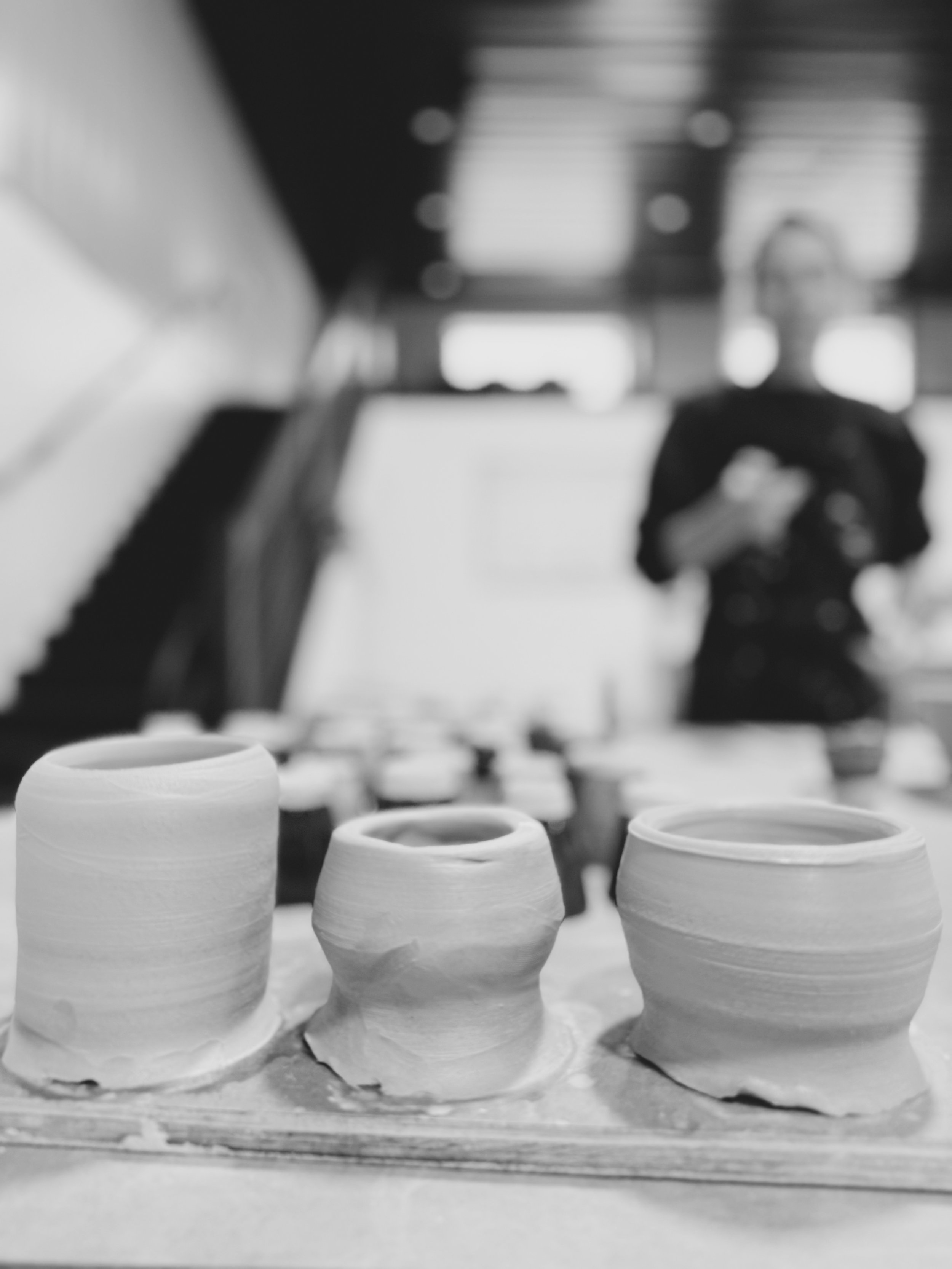
Midway through the class, I learned a new word. Ware board, our instructor said. A simple wooden board where you set a piece that isn't finished, isn't decided, isn't ready for the kiln or the discard pile. You place it there and you walk away. The work rests. You rest. Something in the relationship between you and the object is allowed to breathe.
You can see it, sitting right there, a reminder of sorts.
I turned the word over in my mind. Ware, from the old English for made things. Dinnerware. Hardware. Software. Your wares. A ware board is a board for what you've made, before you've decided what it is.
I was intrigued by the word, fascinated by the concept.
My wife, on the other hand, found the practice unnerving. First, she articulated, you have to decide when you're done throwing the pottery. How do you do that? Then, you have to figure out, through the ware board and process, if what you created will move on.
There's a fragility to it, a firmness, a setting in motion, all at once.
At some point I found myself watching the owner. I'm not sure when exactly, somewhere between my own attempts to listen to the clay and the moment I stopped trying to impose anything on the wheel. I was curious about her movements. How she crafted the experience. Her hands were measured and determined. Certain but unreserved. There's a contradiction in that I haven't resolved.
The painter Lucian Freud once said that imagination is the ability to see things as they truly are. I think that's what I was watching, not fantasy or imposition, but a kind of radical attentiveness. You'd expect one or the other, precision or receptivity. Instead, she seemed to hold both at once, and the clay responded to it. She had cultivated patience. A productive, almost concerted approach to the clay.
I wanted to understand what I was seeing, so I approached her.
My wife and I love Rodin, I told her. The world of the sculptor who begins with a solid object and slowly chisels away, removing everything but the vision, reveals something profound. It takes our breath away. However, standing in the pottery studio, watching the wheel turn, it felt like something else was at work. Less like removal, more like what? Conversation, maybe. I asked her how she thought about the creative process. How she'd come to think of her art.
The going back and forth.
She said the majority of her work, in her words, is simply following the minerals. They speak to me, she said. They express themselves. She spoke about this passionately. She shapes the objects she crafts through her hands. At the same time, she noted that the direction is already there, in the material, waiting to be actualized.
I didn't have a response to that right away. I'm not sure I do now.
Our son didn't hesitate.
Where I approached the wheel with caution, measuring the distance between what I imagined and what my hands could do, he simply began. The clay responded. Later he told me he was trying to make whatever his fingers were telling him, which is, I think, exactly what the owner meant about following the minerals. He just hadn't needed anyone to teach him the language for it.
He wasn't working with haste. He was working with care. It was a collaboration with his imagination. His entire presence was focused on that act of making.
The owner watched him intently for a moment. She said that he had his own technique. She went on to describe how many people develop a particular relationship with the materials, something intimate and unrepeatable. She shared that there's something, in particular, about childhood, and how children approach the world, that inspires curiosity in herself.
Our son chose two pieces from the wareboard to keep.
As I was watching him, I realized how proud I was. But it was something closer to admiration, for his curiosity, for the joy he took in discovery, for the way he wasn't the least bit constrained by not knowing what he was doing. He hadn't arrived with a philosophy. He hadn't needed one. He didn't look around to see what other people might think. He just followed his heart forward, and the clay met him there.
I thought about the wareboard again.
I thought about setting something down before you've decided what it is. About how that might be less a technique than a disposition, a willingness to leave things unresolved long enough for them to tell you what they are.
He didn't need to be taught that. He already knew.
I was reminded of a quote from the poet Gary Snyder, which I read often.
First, don't move. Second, find out what that teaches you.
We can learn a lot from the wareboard and how children approach the world.