The Color of the Sea
There is a building in San Francisco that seems to move.
The Contemporary Jewish Museum, designed by Daniel Libeskind, is clad in over three thousand blue stainless steel panels that shift in the light, deep indigo to brilliant sky blue, depending on the hour, the clouds, and the angle. In 2019, I was there with my dear friend Connor Burtis, a designer, and we stood in front of it unable to quite name what we were seeing. The color lives in the material itself, produced by a chemical process that makes it permanent, unfadeable. The surface was alive. We filed it away without knowing why.
When we began designing Yochai, that building came back.
Yochai is an AI chevruta, a learning companion built for Jewish canonical texts. A chevruta is a partner, rather than a teacher. You study together, argue together, sit in the difficulty together. The tradition is thousands of years old and it produces a particular kind of knowledge, one that holds conclusions lightly and questions permanently. We wanted to build something that honored that.
The first design problem was color.
Color in Jewish tradition is commanded. The Torah specifies tekhelet, a specific blue-violet, as required for the tzitzit, the fringes worn as reminders of divine instruction. For centuries, the source of that color was lost. The murex snail, which lives in the Mediterranean, was the only creature capable of producing it. When it disappeared from use, so did the color itself, from practice, if never from memory. It became a color people knew they were supposed to have and couldn't.
In the nineteenth century, scholars began to recover it. The murex was identified. The dye was extracted again. Tekhelet came back, as a living requirement, taken up again by those who wanted to complete what had been interrupted.
We wanted Yochai's color to carry that story. Deep blue, drawn from the sea, with restraint. Something that felt recovered rather than chosen.
Years ago, I gave Stefan Sagmeister a tour of Sioux Falls, my city. We stood at the foot of the falls first, the waterfall in the heart of downtown, the city's namesake. We talked about the quartzite, the pink stone pulled from the local quarry that built these buildings, the same stone that had been here for millions of years before anyone named the place. Sagmeister drew a line to Jerusalem. One excavated city and another, stones that carry the weight of meaning. Then we walked through a Montessori school that I helped to build. I showed him what I have always believed about learning. The way to understand the abstract is first through the concrete. The sandpaper letters, which children trace with their fingers before they can write, the body remembers the shape before the mind names it. Montessori understood the prepared environment as epistemology. The arrangement of a space determines what thinking becomes possible inside it. We talked about tactile expressions of learning, about how the hand and the room are teachers too.
That conversation became the spatial philosophy of Yochai. A room, and a space one enters. Entry matters. Thresholds matter. (Enjoy the Mezuzah.) The quality of attention a space asks of you determines what learning becomes possible inside it. Sagmeister's own identity work for the Jewish Museum in Manhattan had already shown me what this looked like at scale, an entire visual system built on sacred geometry, the ancient grid from which the Star of David was formed. Every element drawn from the same source. Beauty doesn't arrive on top of structure, it emerges from inside it.
We wanted the experience of opening Yochai to feel like arriving somewhere. The welcome screen greets you with the Shehecheyanu, the ancient blessing said at first occasions, at moments of return. Who has kept us alive, sustained us, and brought us to this moment. It is not a login. It is an orientation. From there, the design asks for a particular quality of presence: generous whitespace, unhurried typography, a palette drawn from parchment and deep water. Nothing competes for attention. Nothing pulses or notifies. We wanted warmth and rigor in the same breath, an invitation that also holds a standard. The feeling we were after is the one you get when you sit down with a book you have been meaning to read for years and finally open it.
Design is often described as problem-solving. But the best design decisions feel more like collaboration. You encounter something and you know it belongs, because you've been carrying it without knowing. That was the experience of making this identity with my friend and collaborator Samuel Mensah-Bonsu, a designer who asked the same question I did. How do you build something that honors what's already there?
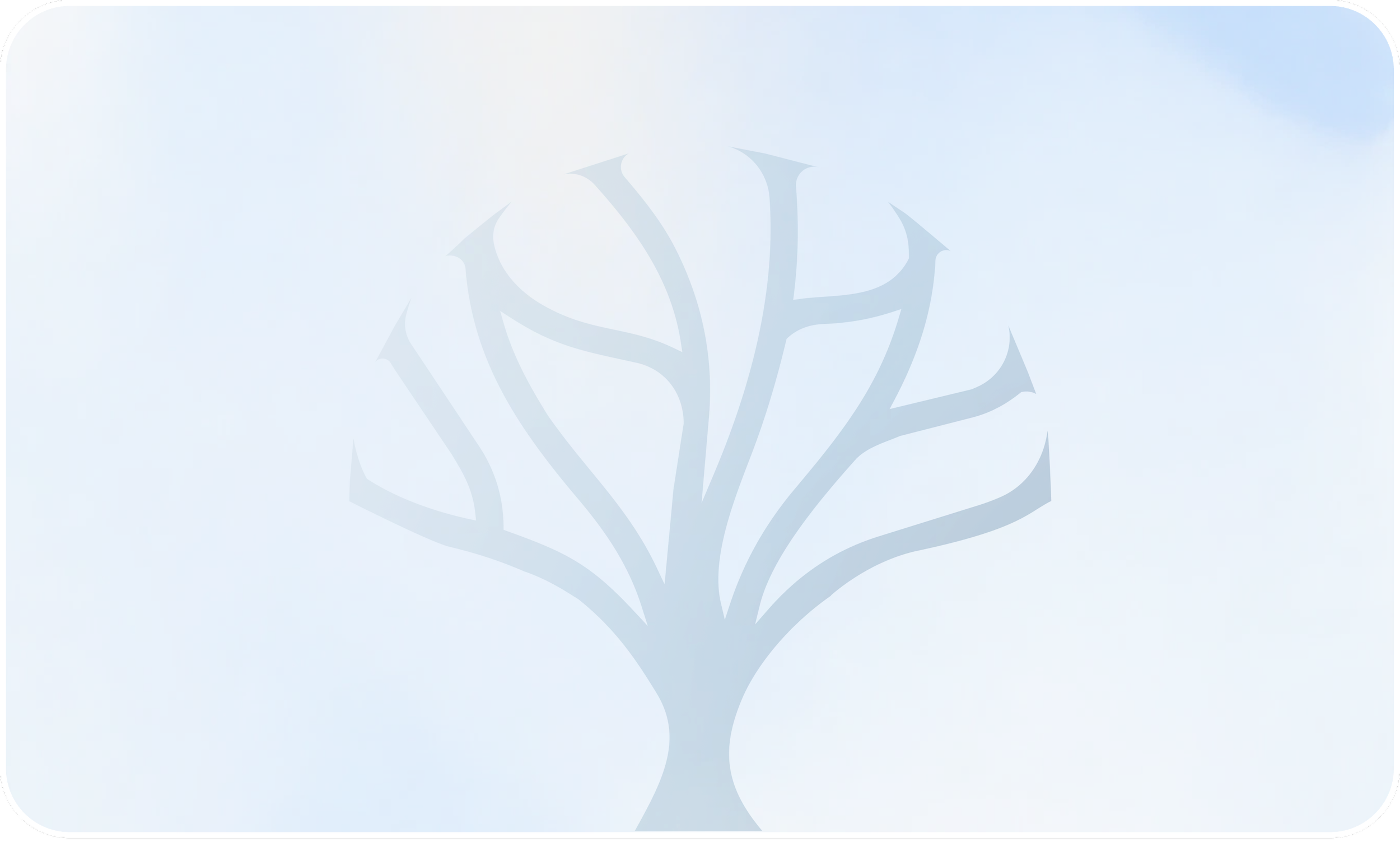
The logo is a carob tree.
Rabbi Shimon bar Yochai, the rabbi for whom Yochai is named, was sentenced to death by the Roman emperor for criticizing the empire. He fled with his son and hid in a cave for twelve years. They studied Torah. A spring appeared in the cave. A carob tree grew at its entrance, miraculously, and they ate from it. When the emperor died and the sentence was lifted, they emerged, so deep in the life of the mind that the ordinary world initially felt intolerable. They returned to the cave for another year to learn how to come back.
The carob tree is a symbol that was waiting. A tree that sustained a man who spent his life in the study of sacred texts, who could not separate learning from living, who needed a year just to remember how to be in the world. We built a learning companion named for him, and the tree is at its center.
What we wanted, finally, was a quiet and luminous place, something that felt like stepping into a beit midrash where ancient texts breathe through modern interfaces. Serious, humane, and safe enough to ask real questions.
What we learned designing this: you excavate rather than invent. Or, you strike new connections and carry on age old conversations. You go back far enough that the color is a snail, the logo is a tree, the inspiration is a steel building that taught you something you couldn't name until you needed it, and a classroom where a child's fingers already knew the answer before the mind caught up.
We think carefully about how the humanities connect with technology. This project has been eye opening and humbling to work on, to connect to such a rich, historic tradition in a thoughtful, meaningful way. The work asks more of us than we expected. We are grateful for that.
The tradition is layered, dialogical, unfinished. We tried to make something that held that. Whether it does is not for us to say. You enter and find out.
Yochai is now open. We'd be honored if you'd come study with us.
Our ancestors planted a carob tree for us. We plant a carob tree for the next generation.